
• CAROTID STENOSIS
    circulation;-anatomy;-carotid-artery

    Transient ischemic attack, or TIA, is a temporary neurological dysfunction caused by a short loss of blood flow to either the brain or spinal cord with no permanent cell damage, or infarction. As opposed to permanent damage, or stroke, the symptoms of TIA resolve within 24 hours. TIA is a risk factor for eventually having a stroke.


    Related Links: Anatomy, Diseases, Complications, Treatment.

  • CORONARY ARTERY DISEASE
    • Chest Pain
      Circulation;-Anatomy;-Heart-draft-2

      Chest pain in general is considered to be an emergency, even though it can be a symptom of a number of medical conditions, the majority of which are not related to the heart. Some of the diseases causing chest pain include coronary ischemia, aortic dissection, pericarditis, cardiac tamponade, pulmonary embolism, pneumonia, pneumothorax, gastro-esophageal reflux disease, costochondritis, radiculopathy, panic attack, anxiety and many others.


      Related Links: Anatomy, Diseases, Complications, Treatment.

    • Shortness Of Breath
      Circulation;-Anatomy;-Heart-draft-2

      Shortness of breath goes by the term dyspnea, or air hunger, and represents a subjective perception of breathlessness. Shortness of breath occur normally during heavy physical exertion, but is pathological if happens in unexpected situations, which is in majority of cases due to diseases of the lungs or the heart.


      Related Links: Anatomy, Diseases, Complications, Treatment.

  • THORACIC AORTIC DISSECTION
    • Back Pain
      circulation;-anatomy;-thoracic-aorta

      Back pain caused by aortic dissection is a so-called radiating pain, or the type of pain felt in a location remote from its origin. It differentiates from such pain as for example local back pain, due to abnormalities in muscles, nerves, bones, joints and other structures of the spine.


      Related Links: Anatomy, Diseases, Complications, Treatment.

    • Chest Pain
      circulation;-anatomy;-thoracic-aorta

      Chest pain in general is considered to be an emergency, even though it can be a symptom of a number of medical conditions, the majority of which are not related to the heart. Some of the diseases causing chest pain include coronary ischemia, aortic dissection, pericarditis, cardiac tamponade, pulmonary embolism, pneumonia, pneumothorax, gastro-esophageal reflux disease, costochondritis, radiculopathy, panic attack, anxiety and many others.


      Related Links: Anatomy, Diseases, Complications, Treatment.

  • ABDOMINAL AORTIC ANEURYSM
    circulation;-anatomy;-abdominal-aorta

    Abdominal pain is a symptom of the widest variety of transient disorders and serious diseases. A triad of hypotension, pulsatile mass in the abdomen and abdominal pain points to the ruptured abdominal aortic aneurysm.


    Related Links: Anatomy, Diseases, Complications, Treatment.

  • ILIAC ANEURYSM
    circulation;-anatomy;-iliac-arteries

    An iliac aneurysm is a dilation of the iliac artery due to decreased elasticity of its wall. The main risk factor of this condition is atherosclerosis; the others include hypercholesterolemia, hypertension and smoking. The so-called, iliac pseudoaneurysm, or false aneurysm, may be caused by trauma or surgery. People with an iliac aneurysm often have no symptoms. When symptoms are present, they include lower back or lower abdominal pain and pain in the groin. The larger an aneurysm becomes, the greater the risk of its rupture. The ruptured aneurysm causes life-threatening internal bleeding.


    Related Links: Anatomy, Diseases, Complications, Treatment.

  • PERIPHERAL ARTERIAL DISEASE
    • Claudication
      circulation;-anatomy;-femoral-arteries

      Claudication, or intermittent limping, usually refers to pain or discomfort in a part of the body, usually a limb, brought by a certain level of physical activity and relieved by rest. In the prevailing majority of cases, claudication is caused by abnormalities in circulation or blood flow. Claudication is different from limping, which is constant pain during physical activity, which is not relieved with rest and occurs usually due to neuro-muscular and skeletal abnormalities.


      Related Links: Anatomy, Diseases, Complications, Treatment.

    • Rest Pain
      circulation;-anatomy;-femoral-arteries

      The term "rest pain" usually refers to a symptom of arterial insufficiency, or ischemia, when an organ does not receive a sufficient amount of blood, not only during physical activity, but even at rest. In an extremity, the rest pain is the next stage after claudication and is followed by a stage called tissue loss, implying formation of ischemic ulcers or dry gangrene. In the heart, pain at rest represents more severe coronary ischemia then the previous stage - pain during exertion - and is followed by irreversible damage called myocardial infarction.


      Related Links: Anatomy, Diseases, Complications, Treatment.

    • Ischemic Ulcers
      circulation;-anatomy;-femoral-arteries

      In general, the term ulcer refers to a chronic three-dimensional defect in the soft tissues. The ulcers almost always develop from acute lesions or a wound not healing due to different reasons. Circulatory ulcers are usually divided into three major types: ischemic, venous stasis and neuropathic. The ischemic ulcers are a result of arterial atherosclerosis and, therefore, are caused by insufficient delivery of fresh blood. That is the reason why they commonly develop on the tips of the toes, the places most remotely located from the heart. The venous stasis ulcers have a different mechanism of formation. They usually appear due to leakage of soft tissue edema, preventing accidental wounds from healing. That happens most often in parts of the body with the most gravity dependent congestion - the ankles. The neuropathic ulcers, including diabetic ones, form on the bottom of the foot, the place with the highest mechanical pressure. That is where innocent accidental wounds fail to heal due to abnormally regulated blood flow in the microscopic blood vessels - capillaries.


      Related Links: Anatomy, Diseases, Complications, Treatment.

  • POPLITEAL ARTERY ANEURYSM
    circulation;-anatomy;-popliteal-arteries

    Asymptomatic usually refers to a disease or its stage with no symptoms, either subjective or objective. Absence of symptoms can be due to the early stage of a disease or the absence of nerves responsible for the specific perception in the affected organ. It can also result from the damage of such nerves, causing a subjective lack of perception.


    Related Links: Anatomy, Diseases, Complications, Treatment.

  • LYMPHEDEMA
    Circulation;-Anatomy;-inguinal

    Edema, or swelling, means accumulation of fluid in between cells of our body. As opposed to accumulation of fluid inside a specific space, such as a pleural space, for example, which is called hydrothorax, edema is a diffuse phenomena and, therefore, does not have a specific space or cavity where it would collect. In general, edema which affects the entire body is due to global problems affecting the entire body, such as renal failure, hepatic failure, heart failure, etc. Local edema, or swelling of a specific organ or a part of the body, is due to problems affecting this organ exclusively. Some examples of local edema are blunt trauma to an extremity, hepatitis, etc. Isolated edema of the lower extremities is almost always due to circulatory problems of lower extremities. An extreme form of edema of the skin is called anasarca, which refers to fluid diffusely leaking from the skin due to the build up of extreme pressure in soft tissue.


    Related Links: Anatomy, Diseases, Complications, Treatment.

  • DEEP VEIN THROMBOSIS
    • Rest Pain
      circulation;-anatomy;-femoral-arteries

      The term "rest pain" usually refers to a symptom of arterial insufficiency, or ischemia, when an organ does not receive a sufficient amount of the blood not only during physical activity, but even at rest. In an extremity, the rest pain is the next stage after claudication and follows by a stage called tissue loss, implying the formation of ischemic ulcers or dry gangrene. In the heart, pain at rest represents more severe coronary ischemia then the previous stage, or pain during exertion, and is followed by irreversible damage called myocardial infarction.


      Related Links: Anatomy, Diseases, Complications, Treatment.

    • Edema (Swelling)
      circulation;-anatomy;-femoral-arteries

      Edema, or swelling, means accumulation of fluid in between the cells of our body. As opposed to the accumulation of fluid inside a specific space, such as a pleural space, for example, which is called hydrothorax. Edema is a diffuse phenomenon and, therefore, does not have a specific space or cavity where it would collect. In general, edema affecting the entire body is due to global problems which affect the entire body accordingly, such as renal failure, hepatic failure, heart failure, etc. Local edema, or swelling of a specific organ or a part of the body, is due to a problem affecting this organ exclusively. Some examples of local edema are blunt trauma to an extremity, hepatitis, etc. Isolated edema of the lower extremities is almost always due to circulatory problems of the lower extremities. An extreme form of edema of the skin is called anasarca, which refers to fluid diffusely leaking from the skin due to the building up of extreme pressure in the soft tissues.


      Related Links: Anatomy, Diseases, Complications, Treatment.

  • SUPERFICIAL VENOUS INSUFFICIENCY
    • Swelling
      circulation;-anatomy;-femoral-arteries

      Swelling, or edema, is caused by superficial venous insufficiency and is often being confused with cardiogenic or nephrogenic edema, caused by heart or kidney failure correspondingly. Subsequently, edema of venous insufficiency is commonly being treated inappropriately. One of the common examples of such treatment is the one with diuretics, or water pills. When our body retains an excessive amount of water, like in the case of heart or kidney failure, diuretics are appropriate. If, however, the edema is due to superficial venous insufficiency, a problem affecting only lower extremities, the cause of it is not retention, but rather inappropriate distribution of water. That is why diuretics are usually ineffective and often are contraindicated for the treatment of lower extremities edema which is caused by superficial venous insufficiency.


      Related Links: Anatomy, Diseases, Complications, Treatment.

    • Rest Pain
      circulation;-anatomy;-femoral-arteries

      The term "rest pain" usually refers to a symptom of arterial insufficiency, or ischemia, when an organ does not receive a sufficient amount of the blood not only during physical activity, but even at rest. In an extremity, the rest pain is the next stage after claudication and follows by a stage called tissue loss, implying the formation of ischemic ulcers or dry gangrene. In the heart, pain at rest represents more severe coronary ischemia then the previous stage, or pain during exertion, and is followed by irreversible damage called myocardial infarction.


      Related Links: Anatomy, Diseases, Complications, Treatment.

    • Claudication
      circulation;-anatomy;-femoral-arteries

      Claudication, or intermittent limping, usually refers to a pain or discomfort in a part of a body, usually a limb, brought by a certain level of physical activity and relieved by rest. In the prevailing majority of cases, claudication is caused by abnormalities in circulation, or blood flow. Claudication is different from limping, which is constant pain during physical activity, not being relieved with rest and occurring usually due to neuro-muscular and skeletal abnormalities.


      Related Links: Anatomy, Diseases, Complications, Treatment.

    • Cramps
      circulation;-anatomy;-femoral-arteries

      Cramps are defined as exertion of a muscle or a group of muscles without the contraction appropriate for such an exertion. Cramping can take different forms and be tonic, clonic, diffuse, etc. Tonic cramping is painful sudden hardening of a muscle with no visible movement in an extremity supplied by this muscle. Tonic cramping at rest is the most typical symptom of superficial venous insufficiency. Diffuse cramping suggests contractions of the individual fibers in a muscle which are independent from each other. They are usually perceived as a so-called paresthesia, or unpleasant non-painful sensation, and often described as feelings of "crawling", "pins and needles", etc.


      Related Links: Anatomy, Diseases, Complications, Treatment.

    • Numbness
      circulation;-anatomy;-femoral-arteries

      Numbness is a type of so-called paresthesia, or non-painful but unpleasant subjective sensation. More specifically, numbness refers to a decrease in tactile sensation, or an extreme form of which is anesthesia, or complete absence of sensation.


      Related Links: Anatomy, Diseases, Complications, Treatment.

    • Varicosities
      circulation;-anatomy;-femoral-arteries

      In spite of common belief, varicosities or varicose veins, are not a disease, but rather a symptom of a disease called superficial venous insufficiency. Coincidentally, varicose veins are by far not the common symptom of the above disease, meaning that the majority of individuals suffering from superficial venous insufficiency do not have visible bulging veins on their skin. Technically speaking, in the majority of patients with superficial venous insufficiency these varicosities can be seen with the ultrasound, but only some of those people have visible enlarged and twisted veins depending on the thickness of the skin, amount of subcutaneous fat, stage of the disease, depth of these veins, etc. The difference between normal, prominent veins and varicosities, is the presence of tortuosity. When veins become wider under pressure, they also become longer and develop tortuosity without having enough space to remain straight.


      Related Links: Anatomy, Diseases, Complications, Treatment.

    • Spider Veins
      circulation;-anatomy;-femoral-arteries

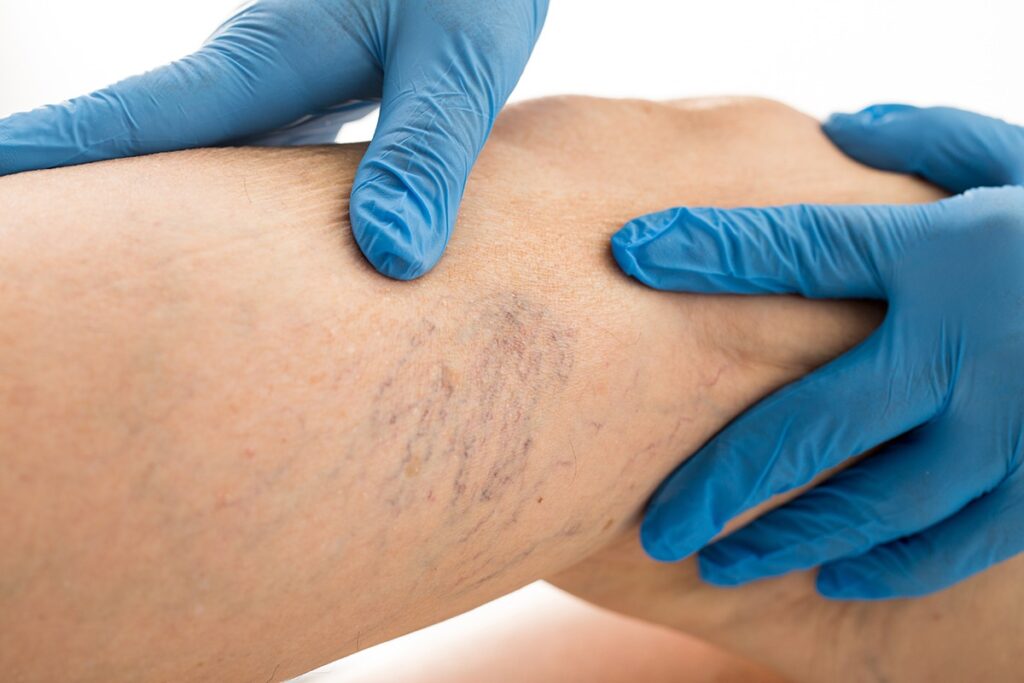
      Spider veins, officially called telangiectasia, are dilated capillaries, terminal venules and terminal arterioles. Their increase in diameter is usually due to either or both congenital weakening of the vessel wall and acquired increase in pressure of the blood entering them. Venous telangiectasias of lower extremities are almost always caused by superficial venous insufficiency. Being usually asymptomatic lesions having only cosmetic importance, rarely such telangiectasias can rupture and cause serious external bleeding.


      Related Links: Anatomy, Diseases, Complications, Treatment.

    • Fatigue
      circulation;-anatomy;-femoral-arteries

      Fatigue is one of the typical symptoms of superficial venous insufficiency, that develops for several reasons. One of them is the fact that swelling represents the accumulation of water in between cells of soft tissues. This water, therefore, increases the weight of the entire extremity, making it heavier. The heavier the leg, the faster we develop the symptoms of fatigue. Additionally, due to the reversal of blood flow through incompetent veins, tissues of the affected lower extremity receive “used” venous blood, which is deprived of oxygen and is saturated with end-products of metabolism, such as lactic acid and others. Muscle cells in absence of normal nutrition become tired quicker. Coincidentally, such fatigue is often described as “legs getting tired out of proportion with the rest of the body”.


      Related Links: Anatomy, Diseases, Complications, Treatment.


Visiting Dr. Khitin was a refreshing experience. I've visited multiple physicians and it looks like most of them treated me like a number. Dr. Khitin has an amazing ability to patiently explain all of the intricacies of the disease. Treatment went smooth. I feel 15 years younger! Thanks doc! –Anastasia L., Manhattan NY

I usually don't write reviews, but I feel that Dr. Lev literally saved my leg. I am 35 and not the typical patient for this kind of stuff, but I had an open ulcer on my leg for 3 years!!! Compression, creams, special diet - nothing helped. After Dr. K's treatment, the ulcer slowly began disappearing and it was gone in 6 weeks. If you ever had an ulcer, you know exactly how I felt! Thank You! Thank You! Thank You! – Mike B., Fair Lawn NJ

I was referred to Dr. Khitin by my primary after suffering for many years from restless leg syndrome and varicose veins. Dr. Khitin is the best! Knowledgeable, experienced, but most importantly, he cares! Relief came shortly after the very first treatment. Definitely recommend this doctor. –Samantha K., Manhattan NY

What a wonderful experience I've had! The problems with my legs are gone! I only wish I came here much earlier! Thank you, thank you, thank you! –Christine P., Manhattan NY

Thank you so much for all your terrific work. I have spent over a decade trying to find the right doctor, while my legs have been getting worse and worse. Dr. Khitin has changed my life and returned my freedom: finally, I can walk independently! –Donna W., Manhattan NY

The most outstanding treatment I have received! All questions answered, tests done, procedures performed and I feel like a new person in no time! Thank you so very much! –Peter R., Philadelphia PA

I have suffered from trophic ulcers for 28 years until I got to Dr. Khitin’s office! He has literally saved my legs! If you have problems with your legs and do not want to get an amputation, do not see any other physician: do see Dr. Khitin right away! –Bob from UPS,  NY

I have traveled thousands of miles to see Dr. Khitin, who literally returned me my health back! Thank you and all your staff for the most wonderful experience! –Dominique S., Montreal, Canada

On behalf of my father, I would like to express our sincere gratitude for your hard work and dedication: you have returned my dad his life and independence back: previously wheel-chair bound for years, now he is walking by himself! –Andre Y., Newark NJ